
DS_Post_Fac
DS_Post_Fac_T2
DS_Post_Sup
DS_Pre_Fac
DS_Pre_Sup
DS_Simp
Variations
DS_Pre_Fac ... .1 ... .1.a ... .Poiss ... .Unif.1 ... .Unif.2 ... .Unif.3 ... .Unif.4 ... .Unif.5
Direction Selective, Pre-Synaptic, Facilitatory
Troyer TW, Krukowski AE, Priebe NJ, Miller KD (1998) Contrast-invariant orientation tuning in cat visual cortex: thalamocortical input tuning and correlation-based intracortical connectivity. J Neurosci 18:5908--5927.
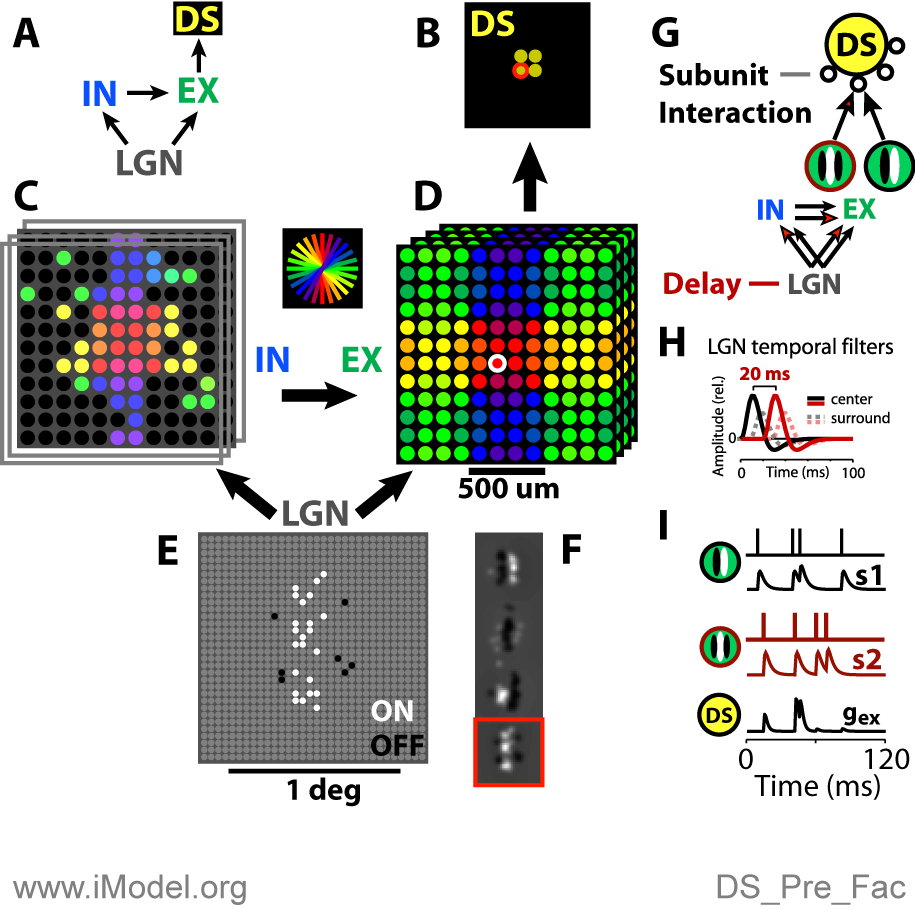
(B) A population of four V1 DS complex cells.
(C) Within a 12,12,4 (x,y,z) lattice of V1 inhibitory simple cells (IN), cells in the 3rd z-layer that are presynaptic to the white-circled cell in (D) are shown in color. Colors indicate preferred orientation (see orientation key between panels C and D).
(D) The 12,12,4 lattice of V1 excitatory simple cells (EX) is shown where color indicates orientation (see orientation key). The white-circled cell gets IN inputs as marked in (C) and LGN inputs as marked in (E). The spatial LGN-driven excitatory RF is shown at the bottom of F (red square). This cell contributes input to the DS cell in (B, red-circle).
(E) The LGN lattice is 32,32,2, where the two z-layers represent ON and OFF cells. The 12,12,4 lattices of EX and IN cells align to the central 12,12 sub-grid of cells in the LGN, in terms of their RF centers within the field of view.
(F) Approximate spatial RFs for the four EX cells at the x,y position indicated by the white circle in (D). Note that the spatial phase of the RF shifts by 90 deg between z-layers.
(G) Each DS cell in (B) receives an excitatory conductance that is the sum of signals from subunits that operate on pairs of EX inputs. The RFs of the inputs pairs are approximately in quadrature (90 deg phase shift). One EX input in the pair (circled in red) receives IN and LGN inputs (red arrows) driven by an LGN population that incorporates an added delay in spike time latency of 20 ms.
(H) The difference in time delay between the two LGN populations is achieved by shifting the temporal filter for units in one population (LGN_D) by 20 ms (red plot) relative to the other LGN population (black plot).
(I) The spike trains from each EX unit in a subunit pair are convolved by the unitary postsynaptic conductance waveform to form two signals, s1 and s2. These signals are then multiplied together and rescaled to generate an input conductance from the subunit. The resulting conductance from many subunits is summed to form the total conductance to the post-synaptic DS unit.